
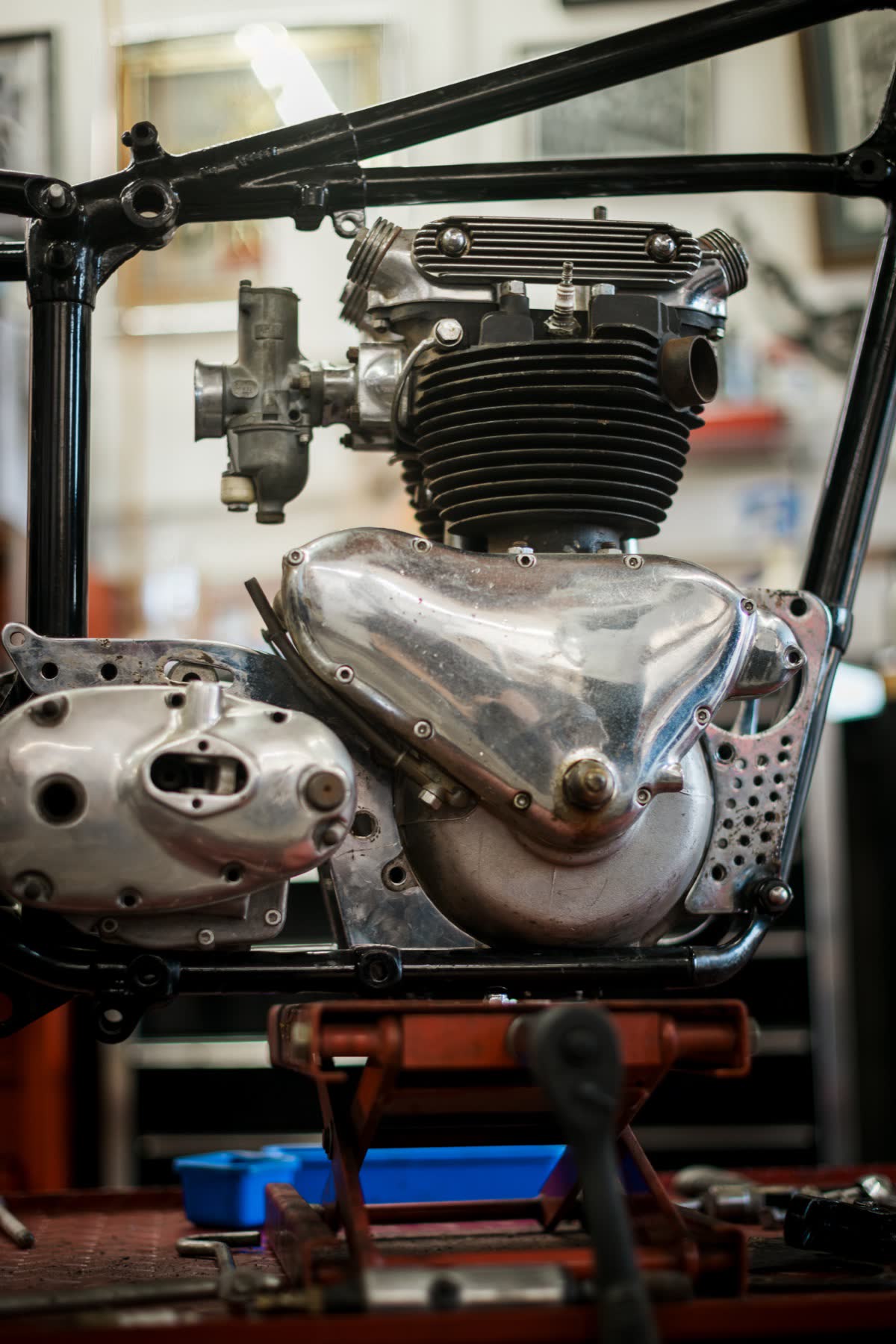
Walk into any Triumph swap meet and you’ll hear the words bouncing around the booths all day: pre-unit, unit, OIF, "is that a ’62 or a ’63?" If you’re new to old British twins it sounds like trivia. It isn’t. It’s the single most important thing to know before you hand someone a check.
So here it is, plainly: pre-unit and unit construction refer to how the engine and gearbox are bolted together. Pre-unit bikes have two separate cases (engine in front, gearbox behind) connected by a primary chain inside a chaincase. Unit-construction bikes have the engine and gearbox living in the same single casting, with the primary chain still in there but everything sharing one set of cases and one oil bath of consequences.
What changed in ’63
Triumph went unit construction in stages. The 500cc twins (T100, Tiger 100) got the new layout in 1959. The 650s, the bikes most people are arguing about, switched over for the 1963 model year. So a ’62 Bonneville is pre-unit. A ’63 Bonneville is unit. Same name on the tank, very different bike underneath.
The change wasn’t cosmetic. Unit construction was lighter, more rigid, easier to manufacture, and quieter (the gearbox sharing a case with the engine cuts down on the rattles you get from a separate ’box bolted to a frame). It also meant Triumph could redesign the primary drive with a built-in tensioner. If you’ve ever tried to set the chain on a pre-unit, that will sound to you like the most important sentence in this article.
A ’62 Bonneville is pre-unit. A ’63 Bonneville is unit. Same name on the tank, very different bike underneath.
How to tell at a glance
Get used to looking at the right side of the bike (the timing side, where the primary chaincase lives) and the gap between the engine and gearbox.
- Pre-unit: you can see daylight, or at least a clearly separate gearbox case, sitting behind the engine. The primary chaincase is bolted onto the engine and the gearbox like a bridge between two buildings.
- Unit: no gap. The bottom of the engine flows into the gearbox in one continuous casting. The whole bottom of the motor looks like one shape rather than two.
- Oil-in-frame (OIF): a sub-category of unit construction from 1971 onward, where the frame’s big top tube is also the oil tank. Tall seat height, polarizing looks. Worth its own write-up.
On the road
A well-sorted pre-unit and a well-sorted unit feel more alike than the forum threads will tell you. Both are stubby, mid-50s-horsepower parallel twins with character measured in vibrations per minute. Where they differ:
- Pre-units tend to feel taller-geared and a touch lazier off the bottom, partly because of the gearbox internals and partly because most are running 1950s-era ratios.
- Unit twins, especially ’66–’70 T120s, are the sharpest stock-spec Triumphs of the era. Twin Amal 30mms, lighter bottom end, better breathing.
- Pre-units sound different too: a slightly looser, more old-fashioned bark. We can’t tell you why, only that it’s real.
In the garage
This is where the decision gets practical. Pre-unit primary chain adjustment is done by moving the gearbox in its frame plates, which means breaking the rear chain, slacking the engine plates, and walking the whole gearbox forward or backward to set tension. It’s not hard. It’s just a thing you have to do. Get it wrong and you’re chewing through primary chains.
Unit bikes hide a sprung primary tensioner behind the chaincase cover. You pull the cover, swap a shim, button it back up, ride. Maybe an hour from cold to tested.
Parts availability favors unit bikes too. They were built in much larger numbers, and the aftermarket has a deeper bench. Pre-unit specifics (gearbox internals, specific chaincase parts, magnetos on the earliest bikes) aren’t hard to source if you know where to look, but they cost more and you’re going to wait longer.
So which should you buy?
If you want the most ridable, easiest-to-maintain vintage Triumph experience, get a ’66–’70 T120. That’s the sweet spot. Twin carbs, unit case, pre-OIF frame, plenty of parts, plenty of know-how out there. We sell more of these than anything else and there’s a reason.
If you want the visual drama of a separate gearbox, a magneto, alloy primary chaincases that catch the light, and a bike that looks like the actual 1959 it was built in, get a pre-unit. They’re harder to live with by maybe 15%. They’re also the best-looking Triumph twins ever made, and we won’t argue otherwise.
If you want a dirt-going desert sled with attitude, get a TR6C (unit) or a pre-unit Trophy converted for off-road. Either is correct.
And if you don’t know yet, that’s fine. Come by the shop. We’ll roll three different twins out of the racks and you can sit on them, listen to them run, and pick the one that sounds like yours.