
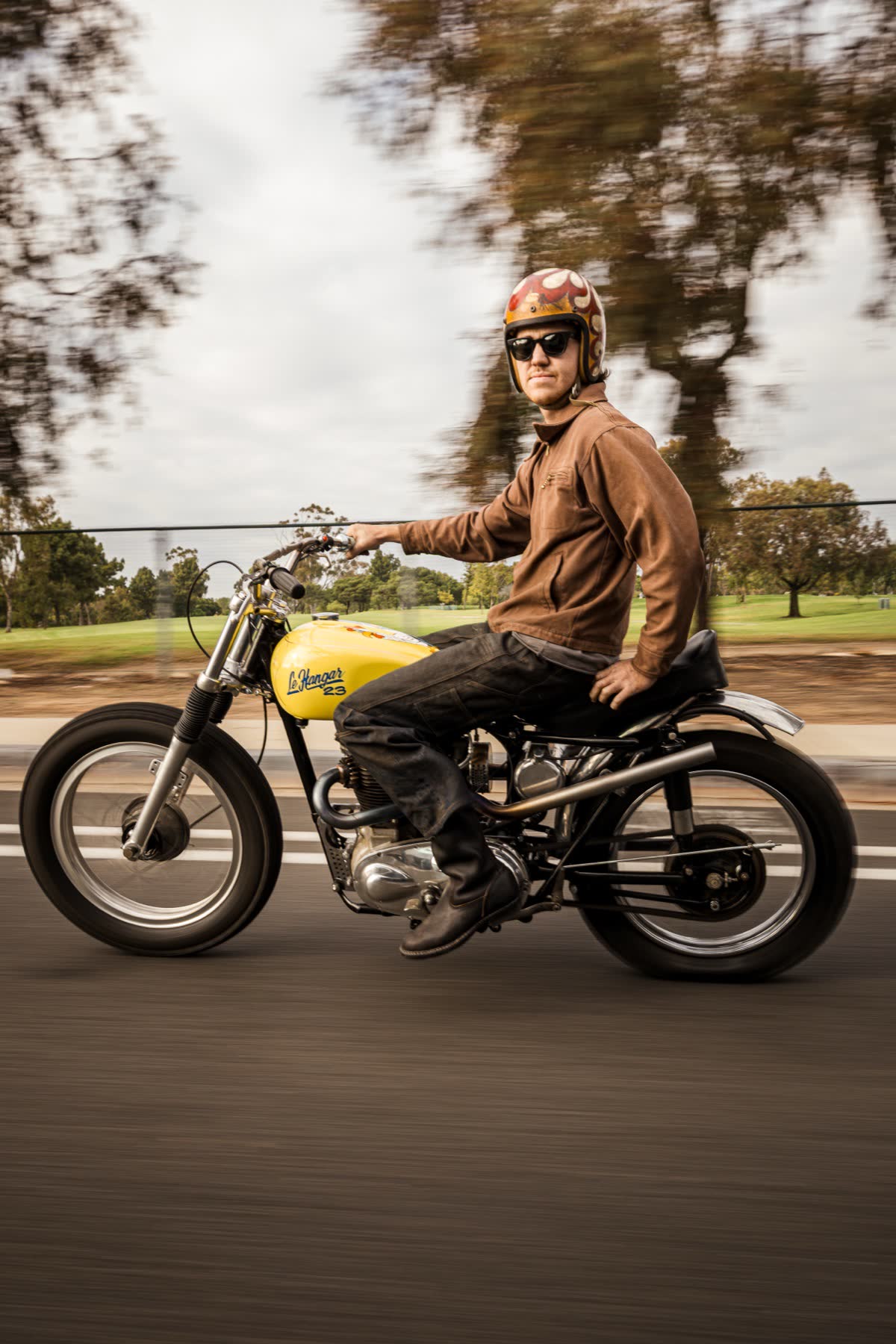
There are three categories of bike that share a silhouette and almost nothing else. The vocabulary got muddy when modern manufacturers borrowed the word for their road-going lineups, and now half of the people online cannot tell you what the categories actually are. So here is what each one is, what it rides like, and which one is the one you actually want.
Desert sled
1956 to 1972, almost exclusively Triumph TR6 or TR6C-derived, single Amal, high pipes, knobbies, small tank, period-correct. Built for a single purpose: winning desert races in California.
Rides like a dirt bike with a license plate. Pavement is uncomfortable past 60 mph because the gearing is low and the wheelbase is short. The real surface for this bike is sand, smooth fire road, and the perimeter of a dry lakebed. Five miles of dirt is more enjoyable than twenty miles of highway.
Scrambler (vintage)
1955 to 1975, broader category. Any street bike modified or factory-built for occasional off-road use. High pipes, on/off road tires, less stripped than a desert sled. BSA, Triumph, Norton, Matchless, Royal Enfield all made scramblers. The category was always more about format than commitment.
A scrambler can be a desert sled. A desert sled is one type of scrambler. The relationship is hierarchical. Every desert sled is a scrambler. Most scramblers are not desert sleds — they are road bikes with capability rather than dedicated off-road machines.
Rides closer to 50/50 on and off road, depending on tires and gearing. A BSA Hornet or a Triumph TR6R with mild changes is the comfortable middle of this category.
Modern scrambler
2006 to present. A manufacturer term for a mid-displacement street bike with high pipes and dual-purpose tires. Hinckley Triumph Scrambler 900, the Ducati Scrambler line, BMW R nineT Scrambler, several Royal Enfield variants. The category exists because Triumph reintroduced the word in 2006 and it sold well.
Rides like a road bike that has been styled. Comfortable on the freeway. Capable on a dirt road if the dirt road is dry and not particularly demanding. The bikes are good at what they are — daily-rideable retros — and would be embarrassed by 50 miles of the Mojave.
Why this matters when you buy
You can commute a modern scrambler and call it a weekend bike. You cannot commute a desert sled. The bikes are not the same product and pretending they are sets up buyers for a long disappointing relationship with the wrong choice.
A vintage scrambler is the comfortable middle for most riders: actual character, real off-road capability if you build it that way, manageable on the street for a 50-mile day. The 1966 to 1970 Triumph TR6R with knobby tires and a smaller tank is what most "scrambler" buyers actually want, even if they came in asking for a desert sled.
You can commute a modern scrambler. You cannot commute a desert sled. They are not the same product.
The vocabulary
The word got muddy because Triumph’s marketing department brought it back in 2006 and Ducati copied them and now every bike with high pipes is a scrambler. That happened. We are not going to win the argument with the wider internet. But in the shop, the words mean specific things, and the bikes are different bikes. If you walk in and ask for a scrambler, we are going to ask which kind you mean, and the answer will move the conversation forward.